Skip to content
Memory Numbers
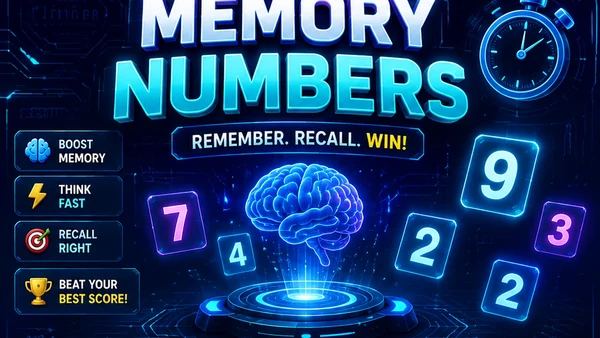
Memory Numbers browser mini game artwork — a glowing blue holographic brain on a tech pedestal surrounded by floating neon number cards and a stopwatch under the Memory Numbers logo
Random challenge

Memory Numbers

A sequence of digits flashes for 2 seconds. Type it back. Each success adds a digit.

3

Memory Numbers: complete guide

Rules, tips and answers for this free browser mini-game.

About this game

Memory Numbers is a working-memory test in game form. A sequence of digits appears for a couple of seconds, disappears, and you type it back from memory using the on-screen keypad. Get it right and the next sequence is one digit longer. Get it wrong and you start again. It is the shortest possible version of a digit-span assessment, and it reveals your real limit surprisingly quickly.

How to play

  • Watch the digits carefully while they are on screen.
  • Wait for them to disappear.
  • Type the sequence back in the same order using the keypad.
  • Each correct answer adds one more digit to the next sequence.

Game rules

  • The sequence is visible for a fixed short window only.
  • The order of digits must match exactly.
  • A single mistake ends the run and restarts the length.
  • Sequences are generated randomly every round.

Tips to improve your score

  • Chunk the digits into pairs or triples instead of memorising them one by one.
  • Say the sequence under your breath — verbal rehearsal beats visual memory here.
  • Turn numbers into a familiar pattern such as a year or an age.
  • Don't start typing until you have the full sequence held; half-recall causes most failures.
  • Play somewhere quiet. Background noise disrupts verbal rehearsal more than you would expect.

Difficulty

Hard — the difficulty rises with every success until you break.

Average play time

Around 10 to 15 seconds per round, longer as sequences grow.

Skills this game improves

  • Short-term and working memory
  • Chunking and encoding strategies
  • Focused recall under mild pressure

Why people enjoy this challenge

Every run ends at your personal ceiling, and that ceiling moves with practice. Players enjoy the escalating tension of a sequence that grows one digit at a time, and the clear, unarguable moment where memory finally gives out.

Frequently asked questions

How many digits can most people remember?
Working memory for digits typically sits around seven items, though chunking strategies push many players well beyond that.
How long are the digits shown?
Roughly two seconds, which is enough time to rehearse the sequence but not to write it down.
What happens when I get one wrong?
The run resets to the starting length so you can build back up again.
Does the sequence ever repeat?
No. Digits are randomly generated for every round.
Can memory games actually improve memory?
They reliably improve your performance at this style of task, mostly by teaching you better encoding strategies.

Related games